
Dads Cannot Lead What They Refuse to Feel
Your kids are watching how you handle anger, disappointment, and fear. What are you teaching them?
This question makes most fathers pause. We spend years focused on what we provide—a home, food, and opportunities—but we rarely consider what we demonstrate in the moments that matter most. How do you react when plans fall apart? How do you carry stress? Research shows that fathers who model emotional awareness raise children who better regulate their feelings, build deeper relationships, and develop genuine resilience. Yet many of us follow old patterns we inherited: the belief that feelings expose us, vulnerability invites harm, and real men remain composed.
The price of that inheritance is far steeper than most realize.
The Invisible Inheritance
Most dads did not choose the distance they carry from their emotions. You likely inherited it.
As a child, you probably heard clear messages about how men should handle feelings: minimize them, control them, or channel them into action. “Boys don’t cry.” “Just toughen up.” “Don’t let them see you sweat.” If you are a father now, these ideas might feel like common sense or simply the way things are. They are not. They are harmful remnants of a narrow definition of masculinity that has damaged men and their families in profound ways.
Neuroscience tells us that when you hide your emotions, you teach your kids that feelings are unsafe, shameful, and evidence of your shortcomings. Children learn this not from what you say, but from what you do. They observe you swallow your pain, redirect conversations away from anything personal, or escape into work or entertainment rather than face difficult moments. These actions show that avoidance is the way to survive feelings that don’t feel good.
This is where the leadership gap becomes visible. You cannot guide your children through emotional landscapes you refuse to explore. You cannot teach courage if you only know how to hide. You cannot demonstrate resilience if your strategy is to suppress everything until it erupts
Your kids need more than what you were given.
The Real Power of Leadership Includes Feeling
Some of us have been taught that leadership meant having all the answers, never wavering, and maintaining control at all costs. We confused emotional distance with power. In doing so, we overlooked something essential about what genuine leadership requires.
Emotional intelligence is not the opposite of power. It is the foundation of it.
Real leadership means recognizing your emotions, understanding what they signal, and choosing your response rather than being controlled by impulse. A leader who explodes in anger without understanding why is not powerful—he is out of control. A father who cannot name what he is feeling is not protecting his family—he is destabilizing it. A man who models authentic emotional awareness, however, leads with genuine authority.
Think about the fathers who genuinely shaped your life. Most were not the ones who appeared flawless. They were the ones who could admit uncertainty, apologize when they erred, and sit with you in difficulty without rushing to solve it. They showed you that being a man meant being fully human, capable of protecting others and asking for help, confident yet open to growth.
That is evolved fatherhood. That is the leadership children are not just seeking, but need.
What Happens When Dads Avoid Feelings
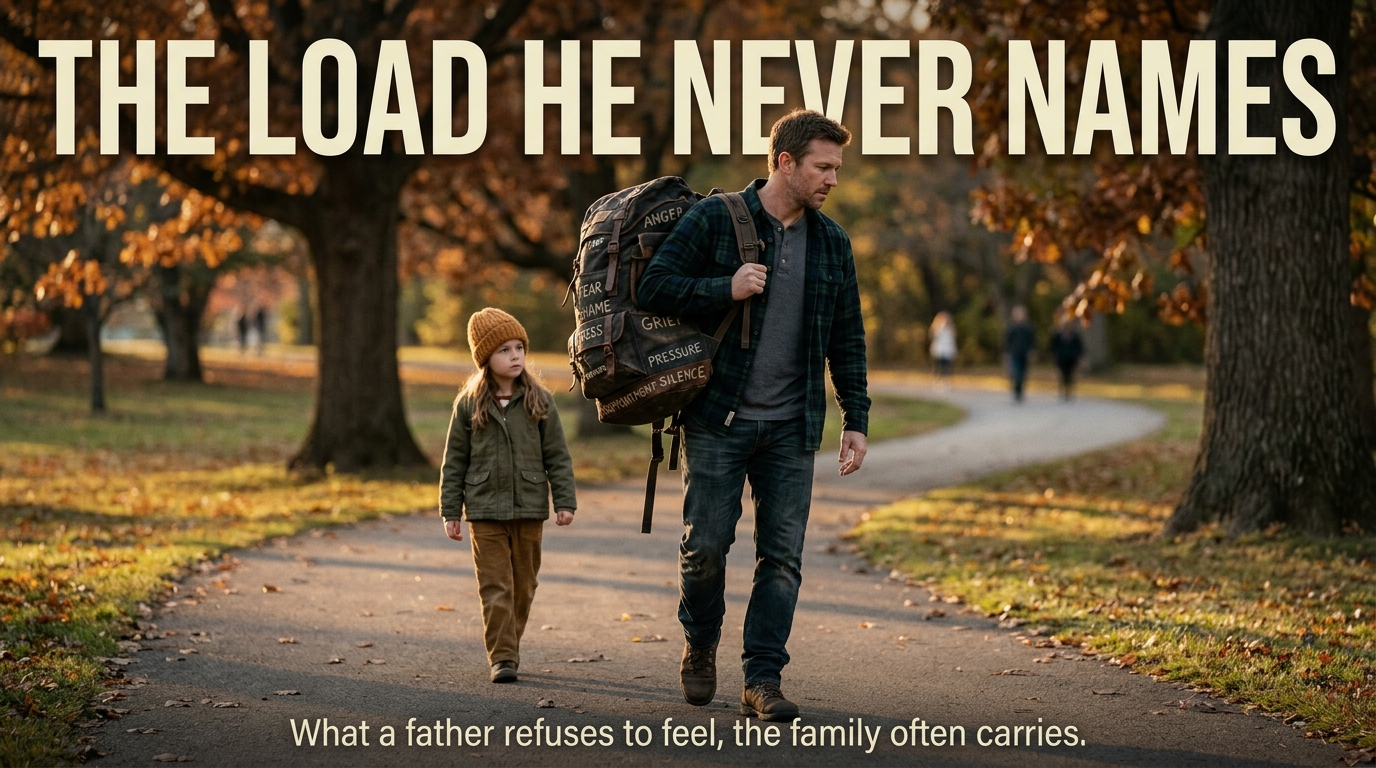
When fathers do not process their own feelings, predictable consequences follow. Relationships deteriorate under the weight of unspoken hurt and disconnection. Mental health declines. Your kids learn to replicate exactly what they see. They bury their own feelings. They develop anxiety about emotions they cannot identify. They struggle in relationships because no one ever showed them how to navigate emotional terrain honestly.
The statistics on men’s mental health are sobering. Men are far less likely to seek help for depression, anxiety, or other mental health challenges. Men represent the majority of suicides. Many men grapple with substance abuse. Beneath most of these crises runs the same current: emotional suppression. The belief that feelings must be managed alone, pushed down, or handled through distraction.
When you avoid your own emotions, it does not stop with you. It shapes your family. That is not leadership. That leaves your family, especially your children, unprepared for how to handle the world in which they live.
The Turning Point
Children do not need a perfect dad. They need a father who faces struggles and discusses them openly. Someone who becomes frustrated, then makes amends. A dad who is not afraid to admit his mistakes and demonstrate repair. Someone who teaches through his own example that emotions are messages, not defects.
Consider what this looks like in actual life.
Your son has a difficult day at school. Instead of immediately offering solutions (“Here is what you should have done”), you create space for him. You ask what he is feeling. You share a time you felt similarly. You do not minimize his experience or rush him past it. You demonstrate that hard days happen, that you have survived yours, and that you remain willing to feel.
Your daughter worries about something. Rather than dismissing her concern or jumping to fix it, you acknowledge it. You tell her about a time you were afraid. You show her that fear is not a sign of something being wrong—it is evidence of being alive and paying attention. You teach her that emotions arrive and depart; they do not stay permanently.
You have a difficult day at work. Instead of shutting down or unloading your frustration onto your family, you say: “I am not in a good place today. I am working through something. It is not about you, and I am going to take some time to process it.” Your kids witness that adults have challenging days. They see that having them does not mean you are broken. They observe you taking responsibility for your own emotional state, and they learn they will need to do the same.
This is what emotional leadership looks like. It is not always neat or tidy. It requires you to be seen. But it is the most transformative thing you can show your kids about being human.
The Path Forward
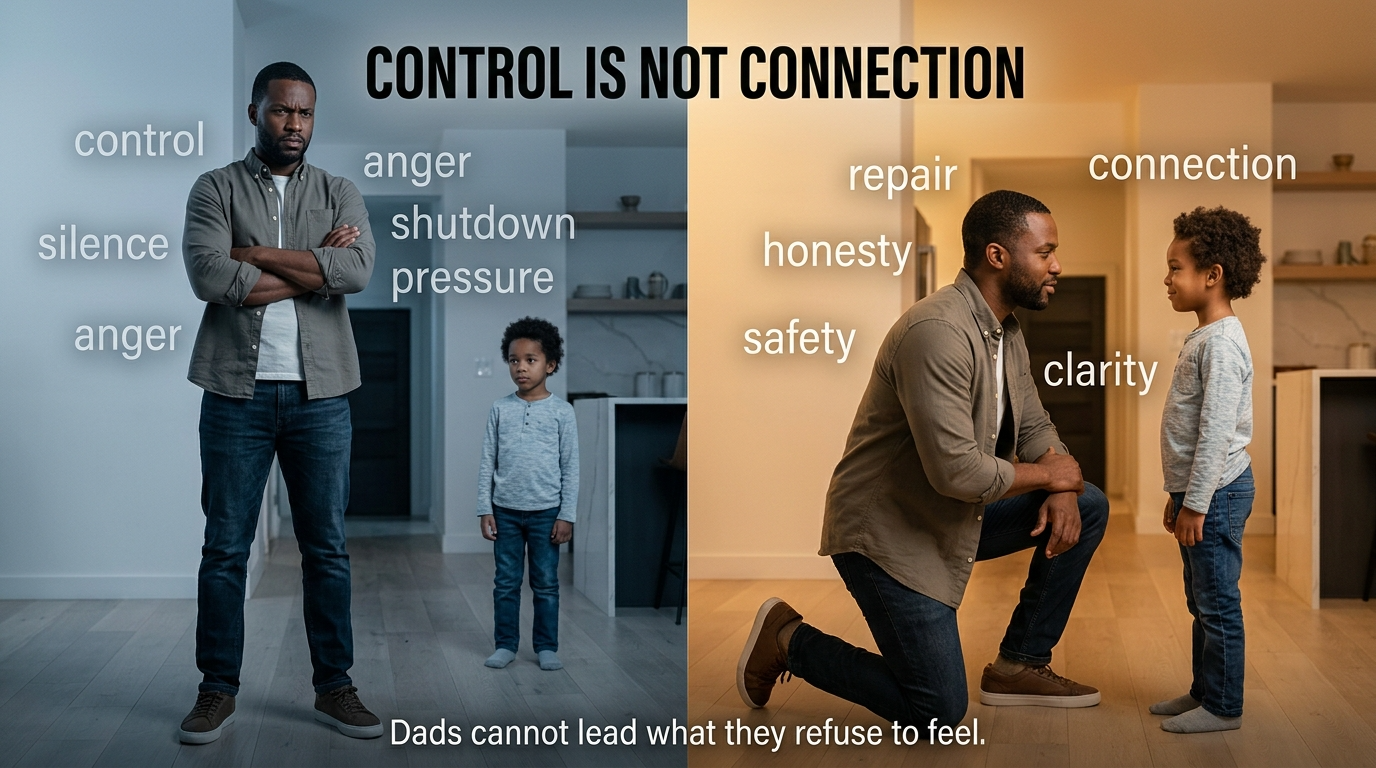
Perhaps you are reading this and thinking: I do not even know where to begin. I have been numb for so long, I cannot remember how to feel.
That is far more common than you might expect, and it is entirely fixable.
I want to encourage you to start small. This week, begin noticing your emotions without evaluating them. Do not try to change anything yet, just name what arises. When you feel tightness in your chest during a difficult conversation, pause and ask yourself: What am I feeling? Is it anger, fear, or shame? Do not suppress it or react immediately. Simply notice it. Naming emotions is the first step toward integrating them.
Find one person you trust to talk to about how you are actually doing. This could be a therapist, a trusted friend, a mentor, or a support group. The purpose is not for them to repair you, but to listen and remind you that you are not the only man who feels this.
Show vulnerability to your kids in ways that match their age. You do not need to share all your adult burdens, but you can be honest. “Dad is managing stress about work right now, and I am learning how to handle it better.” Or, “I made a mistake, and I am sorry. Here is how I will fix it.” Or simply, “I do not know the answer, and that is okay.”
Understand that reconnecting with your emotions takes time. You are retraining patterns that have been in place for years. There will be setbacks. You will slip back into old habits. That is not failure; it is the process. Extend yourself the same grace and patience you would offer your kids.
The Real Leadership Legacy
Being a leader at home is not about control, perfection, or distance. It is about building a space where everyone, including you, can be authentically themselves.
When your kids watch you feel, process, and grow, they learn they can do the same. Witnessing you face challenges and remain standing builds their confidence to handle their own. Your honesty about emotions gives them permission to be open too. When you repair your mistakes, you teach that failure is not final and relationships can survive hardship.
This is not distant authority; it is a lived example of genuine, emotionally intelligent leadership. A father who leads through his emotions possesses far more power than one who leads by avoiding them.
Your kids are watching. They are learning, and they are becoming what they see.
This week, name one emotion you have been avoiding. Just acknowledge it. Sit with it for five minutes. That is where leadership begins.
If this blog spoke to you, I want to invite you to my workshop this month, The Silent Load of Fatherhood.
Join us on 23rd June at 7 pm EST for a conversation about the load dads carry but rarely talk about.
If you want to have a deeper conversation, take the next step. Schedule a free one-on-one consultation with me. I work with parents who are ready to stop hiding and start leading their lives with clarity.


