
Lonely Parents: You Are Not Losing Friends You Are Losing Witnesses
Was there ever a version of you who stayed out past midnight on a Tuesday? Who debated over good movies that you had watched. Who showed up unannounced at a friend’s apartment with takeout containers that did not quite close all the way. Who laughed so hard that your stomach hurt.
Your friends remember that version of you, but you may not.
What if I told you that when we lose our friendships after becoming parents, we are not just losing companionship? We are losing witnesses. We are losing the people who remember the parts of ourselves we stopped using. The parts we set down so carefully, thinking it would only be for a short time, when we picked up our babies.
That loss is not just about loneliness. It is about identity.
Friends Hold Memories of Identities We Stop Exercising

When we have babies, the world starts to look differently and rightfully so. Days become filled with feedings, nap schedules, and before you know it, soccer and baseball games. We become fluent in a new language. We build new competencies and grow in ways we never imagined.
During these beautiful moments, it does not cross our minds that there are parts of our lives that we tend to sit on the shelf. The part that reads literary fiction. The part that cared deeply about local community events. The part that took long runs not to train for anything, but to think. The part that had opinions about art and music and food that had nothing to do with whether it could be consumed with one hand while standing.
Your friends knew those parts of you. They had conversations with those parts. They witnessed your growth in areas unrelated to parenting.
When those friendships fade, you do not just lose someone to text on a Friday night. You lose the only people who remember that you used to be deeply passionate outside of the roles you play now that you are a parent.
Your friends are not just companions. They are mirrors reflecting versions of yourself that parenting does not ask you to be.
When those mirrors disappear, you lose your ability to see those parts of yourself. Sometimes you forget they existed at all.
Why Parenting Turns Friendship Into Calendar Coordination
Friendships do not usually end with a fight after you become a parent. They end with a text thread.
“We should get together soon!”
“Yes! I would love that.”
Three months pass.
“Hey! How about coffee next week?”
“That could work—let me check the kids’ schedule and get back to you.”
Radio silence.
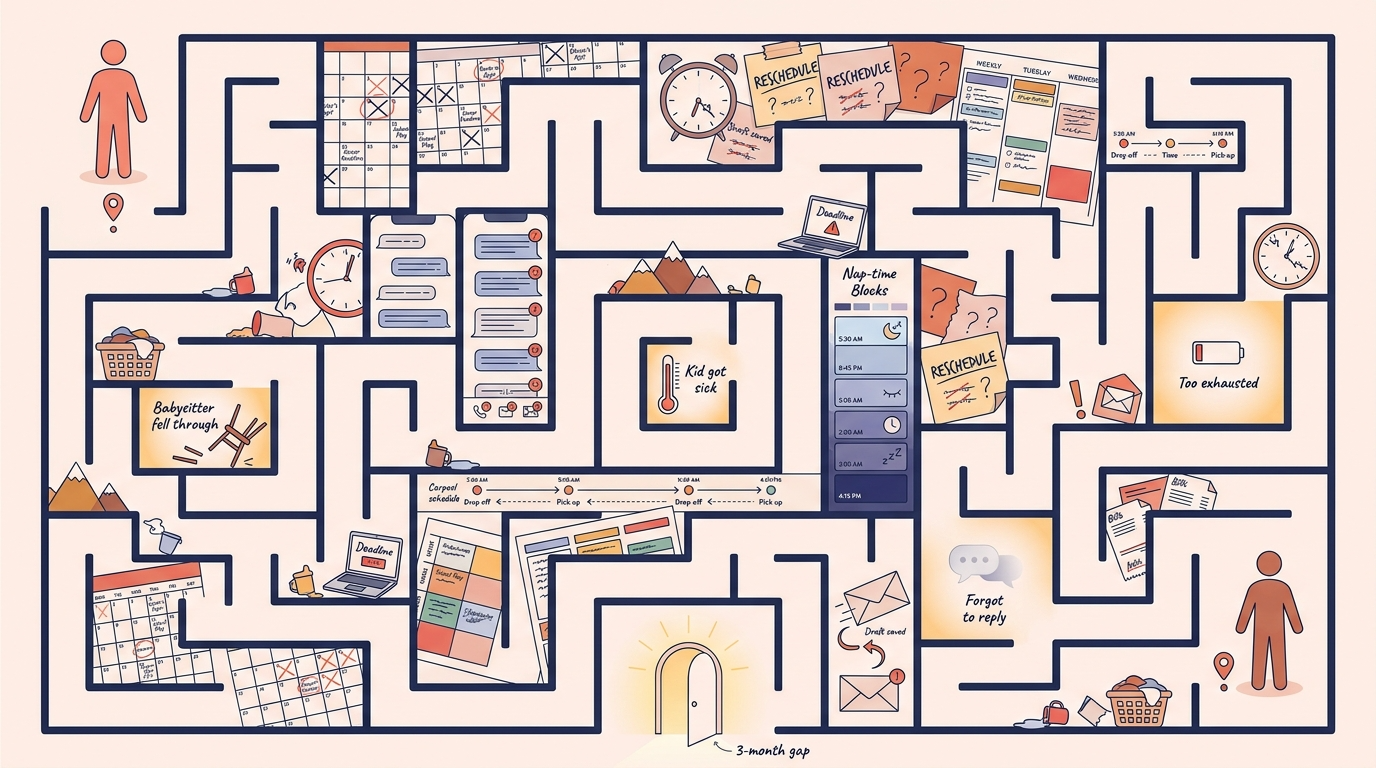
The hard thing is that no one is lying. Everyone genuinely wants to connect. But parenting transforms friendship from spontaneous connection into a logistical puzzle involving nap-time windows, babysitter availability, partner work schedules, and the mental bandwidth to hold a conversation that requires you to finish your sentences.
Friendship becomes another task to manage rather than a space where you get to be.
You start to approach your friendships the way you approach meal planning. You scan your calendar for gaps, calculate drive time, and weigh whether the energy you spend is worth it. It becomes a cost-benefit analysis of connection.
When we become more efficient, we lose some intimacy. You can plan a meetup, but you cannot schedule the kind of three-hour conversation that starts with small talk and ends up changing how you see yourself. That kind of connection needs extra space, unstructured time, and the freedom to be inefficient.
Most parents do not have that anymore.
So friendships shift. They become birthday parties where you supervise children instead of talking to adults. They become group texts filled with memes instead of meaningful conversation. They become holiday cards with updates written in third person about people your friend has never met.
The friendship is not dead, but the intimacy is dormant.
Signs That You Have Become Socially Efficient But Emotionally Disconnected
You may not notice when your friendship starts to fade, but here is what emotional disconnection looks like underneath all that efficient calendar coordination:
You can give a status update, but you cannot remember the last time you told someone how you actually feel. Someone asks how you are, and you default to updates about your children. You have forgotten how to talk about yourself in the first person.
You feel relief when plans get canceled. Feeling that way sometimes is normal. But if it happens often, every cancellation can feel like permission to stay small, stick to your routine, and avoid the vulnerability of being seen.
You cannot remember the last time you laughed until your face hurt. Not a polite chuckle at a kid’s joke. Real, unguarded, gut-deep laughter with another adult who gets you.
You scroll social media to feel connected but close the app feeling more isolated. You see curated highlight reels of other people’s friendships and tell yourself everyone else has figured out how to maintain connection. You are the only one failing at this.
You have entire group texts where no one talks about anything real. Just memes, article links, and surface-level check-ins. No one wants to be the person who makes it heavy. So everyone stays light.
You feel guilty when you think about reaching out. Guilty that you have been absent or don't have energy to be a better friend.
That guilt tells you something. It shows you where you have made yourself smaller, where you have decided your need for connection is selfish, and where you have mixed up being a good parent with disappearing into the role completely.
Why Reconnecting Can Feel Awkward or Guilt-Producing
So why is reconnecting so awkward for so many parents?
You know you need and miss the connections. You also know that your friendships matter. But when you think about actually reaching out, it is so easy to change your mind.
Your mind starts to wonder: what if too much time has passed? What if they are hurt that you have been distant? What if you have nothing interesting to say anymore because your entire life is now school pickups and permission slips? What if you have changed so much that you no longer even know how to be a friend?
Meanwhile, there is another layer of guilt beneath the awkwardness: the guilt of wanting something for yourself.
You love your children. You chose this. You are grateful. So why do you feel this ache for adult connection? Why do you want to talk about something other than parenting? Why do you crave being seen as more than a role?

Three Low-Pressure Ways to Rebuild Connection Without Adding Another Obligation
How can you rebuild a connection without performing more work, which would deter you from wanting to do anything? You need small, sustainable ways to let people back in without the pressure.
1. Send the Messy Text
Stop waiting until you have time for a proper catch-up. Stop crafting the perfect message. Send the messy, unfiltered truth.
“I miss you, and I have been a terrible friend, and I do not even know where to start, but I am thinking about you.”
“I do not have capacity for plans right now, but I need you to know you matter to me.”
Vulnerability reconnects faster than perfection. Your friend does not need you to have it together. They need to know you still want them in your life.
2. Invite Them Into Your Real Life (Not a Scheduled Event)
You do not need to create a special occasion. Invite a friend into what you are already doing.
“I am taking the kids to the park Saturday morning—want to walk with me?”
“I am meal prepping Sunday afternoon and would love company if you are free.”
This takes away the pressure to perform. You are not trying to be who you were before having kids. You are inviting your friend to see who you are now—the person who is still here and still worth knowing.
3. Share What You Are Thinking About (Not Just What You Are Doing)
Start small. In the group text where everyone shares memes, share a thought instead.
“I have been thinking a lot about how I used to define myself, and I am not sure who I am anymore.”
“Does anyone else feel like they have forgotten how to have hobbies?”
You do not need a long conversation. You just need to open the door a little. Let people see that you are still there, still figuring things out, and still growing.
You might be surprised how many people respond. How many of them have been waiting for permission to stop being efficient and start being real.
The Hard Thing About Rebuilding Friendship as a Parent
Reconnecting might feel inefficient. It will not fit perfectly into your schedule. It will take energy you may not think you have. You might have to say no to something else, but staying disconnected costs even more.
You can survive without deep friendship. Many parents do. But survival is not the same as living. Survival is not the same as being rooted.
When you rebuild a connection, you are not just getting friends back. You are getting witnesses back—people who remember who you were before, who can show you the parts of yourself you have set aside, and who can remind you that you are more than what you do for others.
Your friends remember you. Maybe it is time you did, too.
Ready to Reconnect With Yourself and Others?
Rebuilding friendship starts with rebuilding your relationship with yourself. You cannot show up authentically in connection if you have lost touch with who you are beyond your parenting role.
Start here:
📓 FREE Parent Reboot Journal: You need a place to hear yourself think. Download this guided journal to start separating who you are from what you do.
Get your free journal →https://coachkimberlysmith.com/parent-reboot-30-days-to-realign-free-download
💡 Parent Identity Reset: 5-Day Leadership Experience ($24): You see the pattern, but you need help to change it. Join Kimberly for five days of focused coaching to help you face the truth, let go of what is holding you back, and find direction for who you are becoming. This is not about adding more to your plate. It is about remembering you are a person with a plate in the first place.
Start your reset →https://coachkimberlysmith.com/the-parent-identity-reset
You do not have to wait until your kids are older. You do not have to wait until you have more time. You do not have to keep disappearing.
The work begins now. And you do not have to do it alone.


